
How to buy crypto on fomo: your first trade
Buying crypto on fomo is four steps: put money in the account, find the token, confirm which chain it trades on, then buy from your cash balance or straight through Apple Pay. The part nobody explains is what each step costs, because the fee depends on the chain and on how big your first order is. This page walks the flow and prices it.
What do you need before you can buy crypto on fomo?
Three things: an account, money in it, and a token you have actually looked at. The account takes a minute with an email address or Apple ID, and fomo creates the wallet for you through Privy, its wallet provider, so there is no extension to install and no seed phrase to write down.
One step has to happen before all of that. fomo attaches a referral only on the sign-up screen and has no field to add one later, so the fee discount is decided before you ever see a buy button. If you have not registered yet, work through the sign-up steps first; if you want to know what the discount is actually worth, that is on the fomo referral code page. Everything after that is ordinary fomo trading.
How do you put money in before your first trade?
fomo funds one cash balance, and its deposit guide lists three ways in:
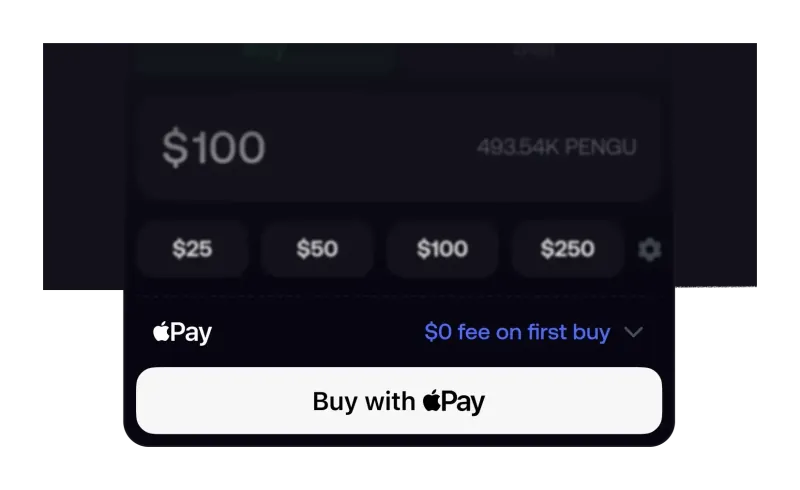
- Apple Pay. Fastest on an iPhone. fomo says you enter the token you want to buy, confirm with biometrics, and the tokens are available immediately — but buying a token directly this way works for select tokens only.
- Debit card. fomo says debit cards from most major banks work, along with some credit cards, and suggests checking your issuer's policy first.
- USDC from an exchange or another wallet. USDC only, and only on Solana, Base or BNB Chain. Another token, or USDC on another network, can be lost for good.
fomo says there is no minimum deposit. It does not publish the fee on Apple Pay or card deposits, so read the amount on the confirmation screen before you approve it. The full funding picture, including how to get money back out, is on our guide to the fomo wallet.
How do you find the token you want to buy?
fomo's app guide describes three routes to a token, and they suit different kinds of buyer:
- Home filters. The home screen has filters including verified, trending and most held. The verified tab only shows tokens fomo's own team has reviewed and marked, which is the sane place for a first trade.
- Search. Search finds tokens and also trader profiles. Type the name and confirm you have the token you meant, not a copycat with the same ticker.
- The social feed and leaderboard. You can see what other traders are buying and turn on notifications for the ones you follow. That is the whole idea behind fomo copy trading — you still place every trade yourself.
Opening a token gives you its price chart, holders and an About section with the project's own links. Use them; a ticker alone tells you nothing.
What does your first buy actually cost?
fomo charges 0.50% per trade on Base, BNB Chain, Monad, Ethereum and Robinhood Chain, and you pay the network fee on top. Solana is the exception twice over: fomo pays the network fee, priority fee and token rent there, but small orders run on a tier schedule rather than a percentage. That makes order size the single biggest lever on a first trade.
| Your first order | fomo fee on Solana | fomo fee on Base and the other four chains |
|---|---|---|
| 3 USDC | 0.10 USDC flat | 0.015 USDC, plus the network fee |
| 25 USDC | 0.50 USDC (2% band) | 0.125 USDC, plus the network fee |
| 100 USDC | 0.95 USDC flat | 0.50 USDC, plus the network fee |
| 250 USDC | 1.25 USDC (0.50%) | 1.25 USDC, plus the network fee |
Two things fall out of that table. A 25 USDC Solana buy is the worst-value trade on the list, because orders from 5 to 47.50 USDC sit in the 2% band; either stay under 5 USDC or step up past 47.50. And on the other five chains the quoted fee is never the whole fee, because the network charges you separately — cheap on Base or BNB Chain, painful on Ethereum.
Selected major tokens are charged 0.05% instead, capped at 0.50 USDC on orders below 1,000 USDC, and a referral takes the standard 0.50% rate down to 0.45%. Every tier and worked example lives in the full fomo fee schedule.
What should you check before you tap buy?
fomo's own guide to spotting bad tokens gives you most of the checklist, and it takes under a minute:
- The chain. It decides your fee and whether you pay gas at all. The same ticker can exist on several chains.
- Verified or not. fomo marks tokens its team has reviewed and shows warnings for high volatility and for potential scams and honeypots. A warning is not a formality.
- Holders. fomo says a team or investors holding more than 60% of supply is a red flag, and that "bundled" launches can hide 20% to 70% of supply across wallets.
- The About section. Links to a real site and real social accounts. If the only proof a token exists is a chat message, that is not proof.
- The amount. Whatever you decide, the fee band you land in is part of the decision.
If the token came to you through a direct message, an airdrop claim or a site that asked you to connect a wallet, stop and read how fomo scams work instead. The real app never asks you to connect an external wallet to sign up.
What happens after you buy?
The token lands in your account and you sell it back the same way, from the token's own screen. Two limits are worth knowing before you build a strategy around fomo. First, we could not find limit orders or stop orders described anywhere in fomo's app guide, fee article or answers pages, so assume you are trading at the price in front of you. Second, fomo publishes an explainer on slippage but does not say whether its app lets you set a slippage tolerance — which matters most on thin tokens, where the price you get can differ from the price you saw.
What fomo does give you after the trade is social: notifications when traders you follow move, and your own profile and position history. If memecoins are what you came for, the risks specific to them are on our fomo meme coin page, and the custody side — who can actually move your funds — is covered under is fomo safe.
How much should a first trade be?
We do not give investment advice, so here is what fomo itself says and what the fee schedule implies. fomo's beginner answers suggest starting with $20 to $50, splitting that into roughly $10 to $15 per trade so you get several attempts, and setting a budget before you start rather than during a drawdown. The fee schedule adds one practical note: at those sizes on Solana you are usually in the 2% band, so the fee is a real share of a small trade rather than a rounding error.
The honest summary for a first buy is that the mechanics are easy and the costs are not obvious. Pick a chain deliberately, size the order so the fee band works for you rather than against you, use the verified list until you know what you are looking at, and get the referral attached at sign-up because that is the only moment it can be. If you have not installed anything yet, start from the fomo app download page.
First trade questions
How much money do you need to buy crypto on fomo?
fomo says there is no minimum deposit. Its own beginner answers suggest starting with $20 to $50 and putting $10 to $15 into each trade. Fees matter more than the amount: a small Solana order can pay 2% while a larger one pays 0.50%.
Can you buy a token on fomo without depositing first?
For select tokens, yes. fomo says you can buy directly with Apple Pay by entering the token you want and confirming with biometrics, and that the tokens are available immediately. Everything else is bought from the cash balance you funded.
Can you set slippage when you buy on fomo?
fomo has not published whether its app exposes a slippage setting. Its own explainer describes slippage tolerance as something trading interfaces generally offer, without saying what the fomo app does. Check the confirmation screen and treat thin tokens carefully.
Does fomo have limit orders for your first trade?
We could not find limit or stop orders described in fomo’s app guide, help center fee article or answers pages, so we do not claim the app has them. Plan on buying and selling at the market price you see.
Which chain should a first trade be on?
For small orders under a few hundred dollars, Solana is usually simplest because fomo pays the network fee, though its fee tiers punish orders between 5 and 47.50 USDC. On every other chain you pay 0.50% plus the network fee yourself.
Verified 15 September 2026. Figures on this page were checked against these sources on that date. fomo can change fees and features at any time; if something here no longer matches, tell us through the contact page and we will update it.
- fomo blog: Navigating your fomo app
- fomo answers: Can I use Apple Pay to buy crypto? (8 February 2026)
- fomo answers: Is $50 too little to start with? (8 February 2026)
- fomo answers: How do I start trading crypto with no experience? (19 February 2026)
- fomo answers: What is slippage in crypto trading? (19 February 2026)
- fomo help center: Trading fees on fomo
- fomo blog: A guide to deposits and withdrawals
- fomo blog: Spotting scams and low-quality tokens (25 December 2025)
- fomo help center: How referral codes and fee discounts work